

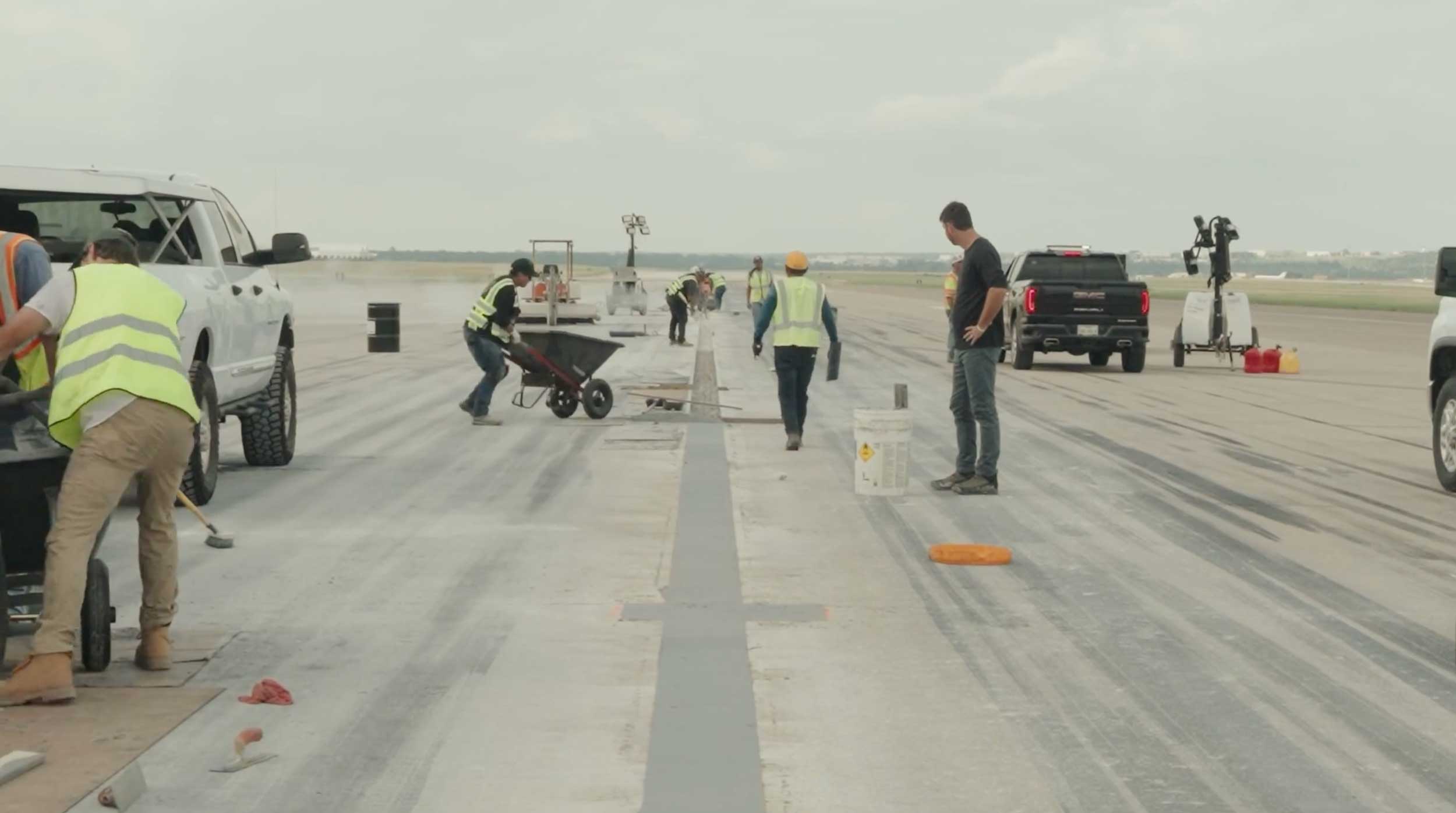
High-Performance Concrete Is Not Standard Concrete
Runways are among the most stressed infrastructure surfaces in the world. Military aircraft impose concentrated wheel loads, high braking forces, thermal shock, and chemical exposure that exceed typical highway pavement conditions.
According to the Federal Aviation Administration (FAA), airfield pavements must maintain structural capacity under repeated heavy loading cycles while minimizing Foreign Object Debris (FOD) risk (FAA AC 150/5320-6F).
Standard concrete repair materials are not engineered for these conditions. High-performance runway repair systems are.
The Importance of Early Strength Development
For military airfields, cure time equals downtime.
Rapid-set concrete repair materials must achieve structural compressive strength quickly — often within 1–2 hours — to safely support aircraft traffic.
This requires advanced cement chemistry designed to:
• Accelerate hydration
• Control shrinkage
• Minimize cracking
• Achieve high early compressive strength
• Maintain long-term durability
Research from the U.S. Army Corps of Engineers highlights the importance of high early-strength repair materials in Rapid Airfield Damage Repair (RADR) scenarios, where operational restoration speed is critical.
Without proper formulation, rapid-set systems may crack, delaminate, or fail under repeated aircraft loads.
True high-performance systems balance speed with structural integrity.
Bond Strength: The Most Overlooked Failure Point
Most runway repair failures occur at the bond line between the new material and the existing slab.
Poor adhesion leads to:
- Delamination
- Secondary spalling
- Water infiltration
- Freeze/thaw degradation
- Premature structural breakdown
High-performance airfield repair materials are engineered for superior mechanical and chemical bonding, ensuring the repair integrates structurally with the original pavement rather than acting as a temporary patch.
This reduces lifecycle maintenance cost and increases long-term runway reliability.
Thermal & Environmental Performance
Military airfields operate in extreme climates:
• Arctic freeze/thaw cycles
• Desert heat expansion
• Coastal moisture exposure
• Jet blast thermal stress
Repair materials must resist:
• Scaling
• Shrinkage cracking
• Chemical degradation
• Cyclic fatigue
The durability of a runway repair system is determined not just by compressive strength, but by how it performs under repeated environmental stress.
High-performance concrete repair systems are engineered to maintain structural stability across wide temperature ranges without premature deterioration.
Load Resistance Under Military Aircraft
Military aircraft create extreme pavement stress concentrations.
Fighter jets and heavy transport aircraft generate:
- High tire pressure loads
- Braking shear forces
- Cyclic fatigue stress
- Heat from jet exhaust
Runway repair materials must restore structural load-bearing capacity immediately upon reopening. This is why high-performance rapid-set concrete systems are essential for military runway repair, ensuring military readiness.
Temporary patching increases risk. Structural restoration preserves readiness.
Why the Science Matters
Air superiority depends on reliable infrastructure. Selecting a high-performance concrete runway repair system ensures:
-
Faster reopening times
-
Reduced FOD risk
-
Longer repair lifespan
-
Lower lifecycle maintenance cost
-
Greater operational resilience
When engineered properly, rapid-set concrete repair becomes a structural solution — not a short-term fix.


