

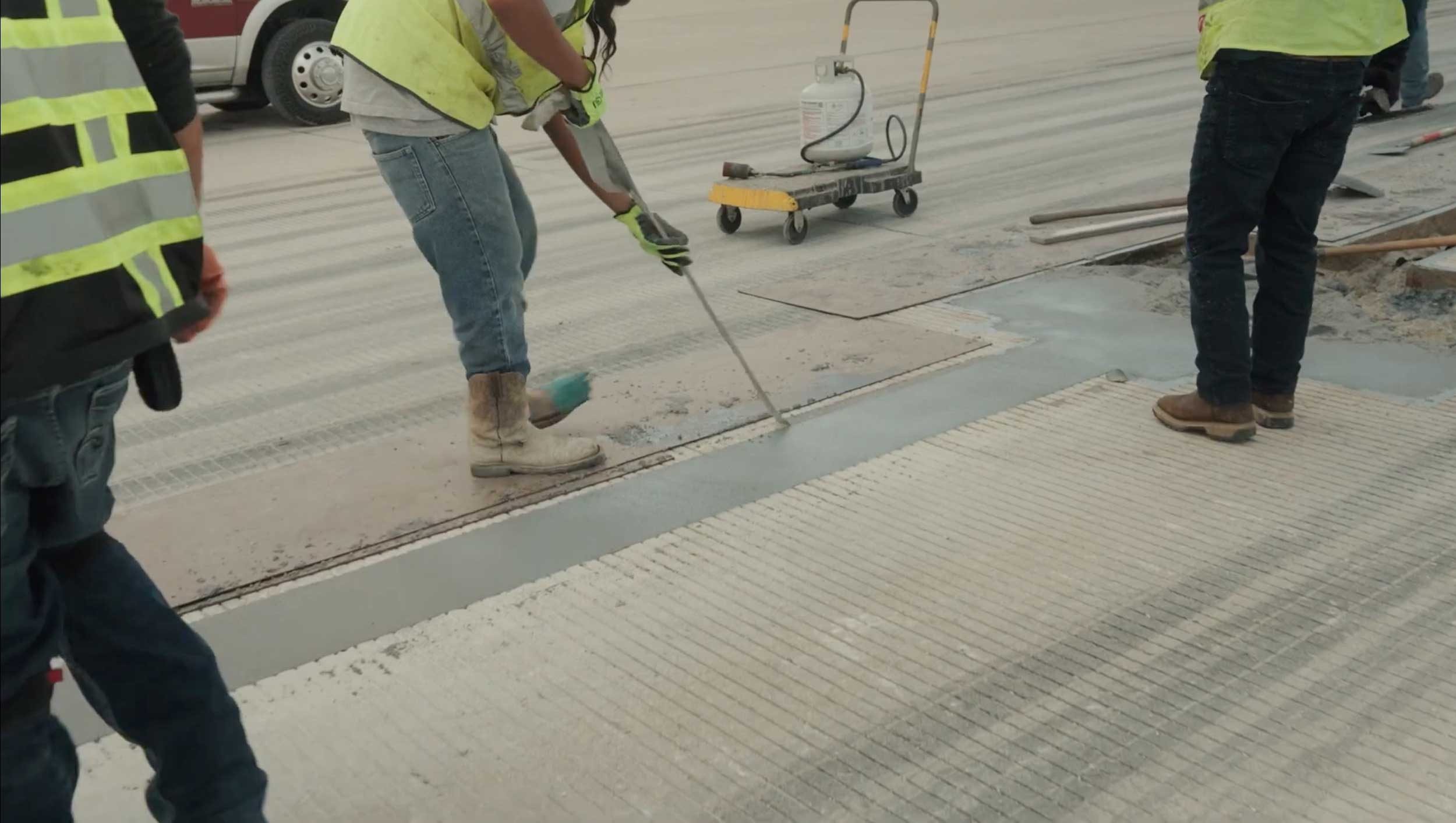
Runway Downtime Is Operational Risk
For military installations and high-traffic airports, runway downtime is more than inconvenience — it is operational disruption.
Every hour an airfield is closed can mean:
-
Reduced sortie generation
-
Delayed deployment schedules
-
Interrupted training cycles
-
Rerouted aircraft
-
Increased logistical strain
According to the Federal Aviation Administration (FAA), maintaining pavement integrity is essential to ensuring safe aircraft operations and minimizing Foreign Object Debris (FOD) hazards (FAA Advisory Circular 150/5380-6C).
For military airfields, runway availability directly impacts mission readiness.
The challenge is clear: how do you minimize runway downtime without compromising structural safety?
The Traditional Tradeoff: Speed vs. Strength
Historically, runway repair required a compromise.
-
Fast repairs lacked durability.
-
Durable repairs required extended cure times.
Traditional concrete replacement can require 12–48 hours before reopening. In military environments, that delay is unacceptable.
Modern rapid runway repair systems eliminate that tradeoff by combining:
-
High early compressive strength
-
Structural bonding
-
Low shrinkage performance
-
Load-bearing capacity within hours
Rapid-set concrete technologies now allow airfields to reopen safely within 1–2 hours while maintaining long-term durability.
Best Practices to Reduce Runway Downtime
1. Prioritize Targeted Spall Repair
Not all runway damage requires full slab replacement.
Localized spall repair using high-performance airfield concrete repair systems restores structural integrity while limiting repair footprint and closure time.
2. Use High Early Strength Concrete
The key to minimizing downtime is early strength development.
Rapid-set runway repair materials are engineered to achieve structural load-bearing capacity quickly. This allows aircraft traffic to resume safely without extended curing delays.
The U.S. Army Corps of Engineers emphasizes rapid restoration capability in airfield pavement repair planning, particularly under contingency or high-tempo conditions.
3. Ensure Superior Bond Strength
Safety depends on more than compressive strength.
Poor bonding between the repair material and the existing concrete leads to:
-
Delamination
-
Secondary spalling
-
Water infiltration
-
Freeze/thaw failure
High-performance airfield repair systems chemically and mechanically integrate with existing pavement, preventing premature failure and reducing future downtime.
4. Choose Materials Engineered for Extreme Environments
Military runways operate in:
-
Desert heat
-
Arctic cold
-
High humidity
-
Coastal salt exposure
Repair systems must resist scaling, cracking, and cyclic fatigue under environmental stress.
Minimizing downtime today should not create failure tomorrow.
Safety Cannot Be Compromised
Reopening a runway quickly means nothing if the repair cannot withstand:
-
Fighter jet braking forces
-
Heavy transport aircraft loads
-
Jet blast shear
-
Cyclic fatigue
High-performance rapid-set runway repair materials are engineered to restore structural capacity immediately, ensuring safe reopening.
This balance between speed and safety defines modern airfield maintenance strategy.
The Strategic Advantage of Rapid Runway Repair
Airfields that adopt advanced rapid repair systems gain:
-
Faster operational recovery
-
Lower lifecycle maintenance cost
-
Reduced FOD risk
-
Greater mission flexibility
-
Improved infrastructure resilience
Runway repair is not simply maintenance.
It is operational continuity planning.
Minimizing downtime while maintaining structural safety is no longer optional — it is strategic.


