
Compliance
FAA-Compliant Runway Repair: P-501, AC 150/5370-16, and Rapid-Set Materials
July 17, 2026
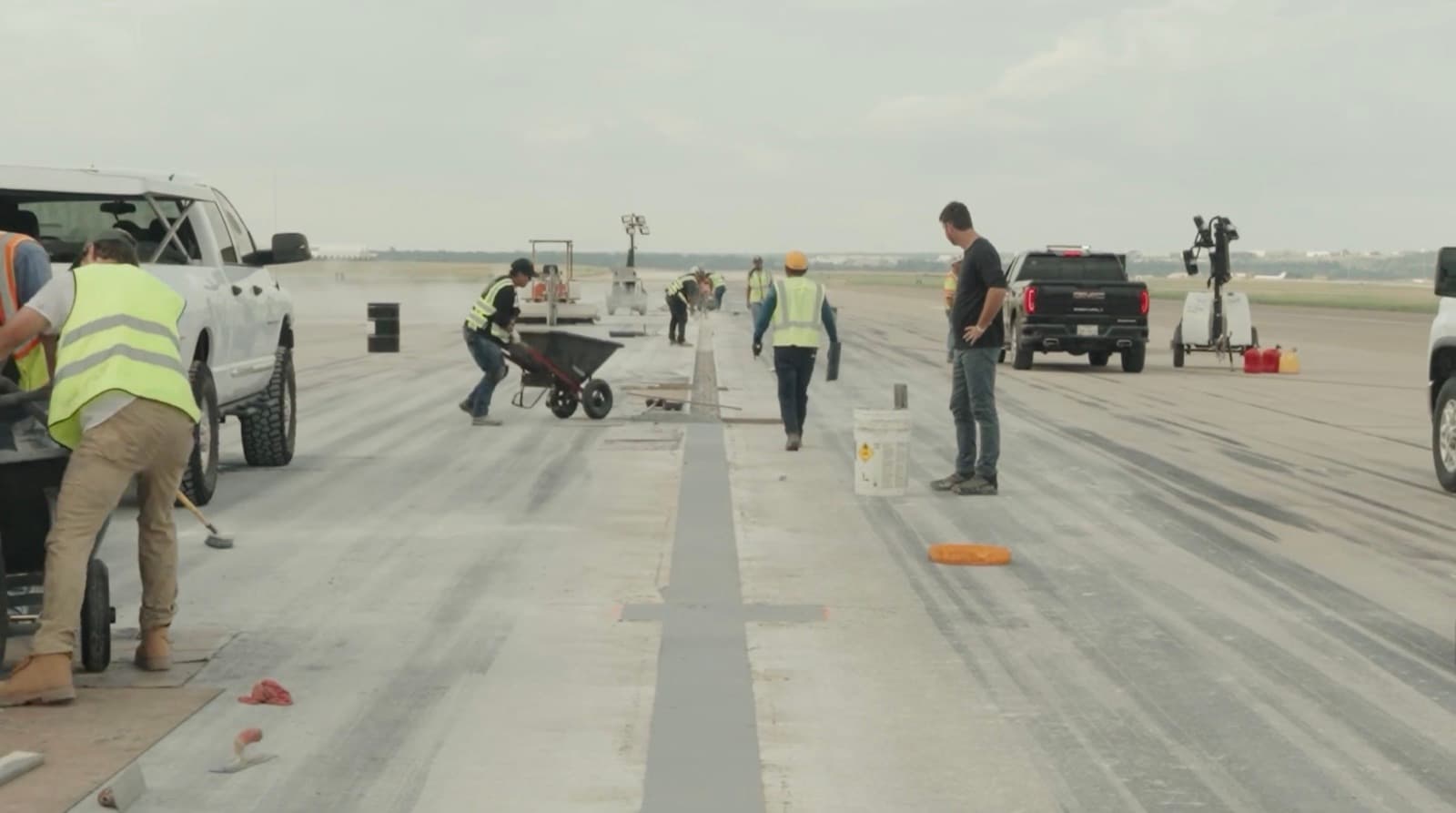
Airport engineers face a hard question when a runway needs repair on a tight closure window: which FAA standard governs the material you pour? The answer is less direct than most expect. FAA guidance covers rigid concrete pavement in detail. It covers planning for rapid construction. But it does not cover the rapid-setting repair materials themselves. That gap shapes every rapid runway repair decision on a federally obligated airfield.
This article maps the FAA framework, explains the material spec gap in plain terms, and lays out how to evaluate a rapid repair material that meets or exceeds FAA requirements.
The FAA framework for rigid airfield pavement
FAA pavement standards live in Advisory Circular 150/5370-10, the standard specifications for construction of airports. Within that document, individual "Items" govern specific materials and methods.
Item P-501: Cement Concrete Pavement
Item P-501 is the FAA standard specification for rigid airport pavement. It governs Portland cement concrete — mix design, materials, placement, jointing, curing, and acceptance testing. When an airport builds or reconstructs a concrete runway, taxiway, or apron on standard timelines, P-501 is the spec.
The key point for repair work: P-501 is written around Portland cement. Its material requirements assume a conventional concrete chemistry and conventional cure times. That framing matters when you need a runway back in service in hours, not days.
AC 150/5370-16: Rapid Construction of Rigid PCC Airfield Pavements
Advisory Circular 150/5370-16 addresses rapid construction directly. Its title — "Rapid Construction of Rigid (Portland Cement Concrete) Airfield Pavements" — signals its scope. It provides planning, management, and testing guidance for completing rigid pavement work inside compressed closure windows.
Read it for what it is: a management document. AC 150/5370-16 helps you plan the closure, sequence the work, and test the result. It does not provide a material specification for rapid-setting products. It assumes Portland cement concrete and focuses on how to build fast, not what alternative material to use.
Alongside these, the FAA cares about surface performance across the board — friction and smoothness are runway safety requirements, and FOD control is governed separately under AC 150/5210-24, Airport FOD Management.
The rapid-set material spec gap
Here is the part every airport engineer should understand, because it is real and it is often misstated.
The FAA has no material specification purpose-built for rapid-setting repair materials.
Item P-501 is limited to Portland cement concrete. Many rapid-set materials — polymer systems, modified cements, and other chemistries engineered for fast return to service — fall outside what P-501 was written to cover. AC 150/5370-16 gives you a rapid-construction playbook but stops short of specifying the material. So there is no single FAA document you can point to that says "this rapid-setting product is approved."
What happens in practice? Airport engineers operate independently. They rely on engineering judgment, project experience, and tested performance data. When a chosen material does not fit inside the standard specification, they file a modification to standards — the FAA mechanism for documenting and justifying a departure from a published standard. The modification is where the rapid-set material gets defined, justified with data, and approved for the specific project.
This is not a loophole. It is the intended path. The absence of a rapid-set material spec means the burden shifts to the engineer to prove performance and document the decision. Understanding that shifts how you should evaluate any product marketed for FAA runway repair.
What this means for choosing a rapid repair material
Because no FAA material spec exists for rapid-set products, you cannot shop for a "P-501 approved" rapid repair material. It does not exist. Instead, evaluate on performance, backed by standardized test data, and document the decision.
A practical evaluation checklist:
- Early strength. Can the material carry aircraft loads inside your closure window? Ask for compressive and tensile data, and the time to reach service strength.
- Bond. Repairs fail at the interface first. Look for bond strength tested to a recognized standard.
- Durability and environment. Impact resistance, thermal range, water absorption, and VOC content all affect service life and site safety.
- Surface performance. The finished repair must meet FAA friction and smoothness requirements. Plan the finish accordingly.
- Documentation. Insist on ASTM-tested data, not marketing numbers. This data is what supports your modification to standards.
Then handle the process: document the modification to standards for the material you select, and plan the closure window using AC 150/5370-16. Pair the right material with the right management plan and you get a repair that is fast, defensible, and durable. For more on compressing the closure itself, see our guide on how to minimize runway downtime.
How SpallKRETE fits
SpallKRETE is a three-component thermoset vinyl polymer repair system engineered for rapid return to service. It meets or exceeds MIL-STD and FAA requirements for runway repair materials. It is not a Portland cement product, so — like other rapid-set materials — it is evaluated on tested performance and documented through a modification to standards, not through a P-501 approval that does not exist for any rapid-set product.
The performance data that supports that evaluation, all from standardized testing:
- Compressive strength: 11,412 PSI (ASTM D695)
- Tensile strength: 1,054 lb/in² (ASTM D638)
- Bond strength: 16,268 lb peak (ASTM C882)
- Impact resistance: 83 ft-lbf at −20°F
- Water absorption: 0.64% (ASTM D570)
- VOC: <0.01
- Continuous temperature limit: 175°F
- Climate range: −40°F to 120°F
Operationally, SpallKRETE mixes in under five minutes and returns pavement to service in as little as one to two hours. Application follows a defined process: saw and chip the spall to roughly 3 inches, prime with SpallPRIME, power-mix resin and catalyst, add aggregate, and trowel. For background on why spalls form and how they progress, see spalling on runways: causes and repair.
Frequently Asked Questions
Does the FAA have a specification for rapid-setting runway repair materials?
No. The FAA has no material specification purpose-built for rapid-setting repair materials. Item P-501 covers Portland cement concrete only, and AC 150/5370-16 provides rapid-construction planning guidance without specifying materials. Airports operate independently and engineers typically file a modification to standards to document and justify the rapid-set material they select.
What is FAA Item P-501?
Item P-501, Cement Concrete Pavement, is the FAA standard specification for rigid airport pavement. It is part of AC 150/5370-10 and governs Portland cement concrete — mix design, placement, jointing, curing, and acceptance. It is written around Portland cement and does not cover alternative rapid-set chemistries.
What is AC 150/5370-16?
AC 150/5370-16, "Rapid Construction of Rigid (Portland Cement Concrete) Airfield Pavements," is FAA guidance for planning, managing, and testing rapid rigid-pavement work. It helps you plan a compressed closure window. It does not provide a material specification for rapid-setting repair products.
Can you use rapid-set concrete on an FAA runway?
Yes. Rapid-set materials are used on federally obligated airfields. Because no FAA material spec covers them, the engineer evaluates the product on tested performance — early strength, bond, durability, and surface friction — and documents a modification to standards for the project.
How do I prove a rapid repair material is compliant?
Compliance is demonstrated through performance, not a certificate. Use ASTM-tested data to show the material meets FAA performance and surface requirements, document a modification to standards, and plan the closure per AC 150/5370-16.
Evaluate SpallKRETE for your next runway repair
If you are scoping a rapid runway or apron repair on a federally obligated airfield, request the full SpallKRETE data package and specification support. We provide the ASTM-tested performance data that supports your modification to standards and closure plan.
Start an RFP or quote request, or reach our team directly at adominguez@spallkrete.com.
Next Step
Need SpallKRETE for your airfield?
Request a proposal or download the technical spec sheet.